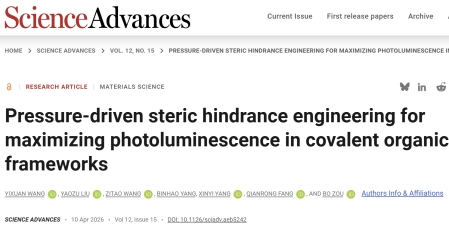
Recently, a research team led by Professor Yang Xinyi from the group of Professor Zou Bo at the State Key Laboratory of High Pressure and Superhard Materials / Center for High Pressure Science and Technology Advanced Research (HPSTAR), Jilin University, in collaboration with Professor Fang Qianrong from the State Key Laboratory of Inorganic Synthesis and Preparative Chemistry, Jilin University, realized enhanced yellow fluorescence and atmospheric-pressure trapping of pyrene-based imine covalent organic frameworks (COFs) denoted Py-Da-4CH₃-COF by combining pressure processing engineering with steric hindrance effects. The fluorescence quantum yield was drastically elevated from 14.7% to 91.5%. The relevant findings were published inScience Advancesunder the title "Pressure-driven steric hindrance engineering for maximizing photoluminescence in covalent organic frameworks."
High-performance intelligent photoluminescent materials hold broad application prospects in display devices, biological imaging, chemical sensing, and other fields. Benefiting from their long-range ordered π-conjugated structures, customizable functional building blocks, and diverse electron transition modes, COFs serve as a distinctive platform for constructing smart stimuli-responsive luminescent materials. Nevertheless, non-radiative decay pathways originating from π–π stacking and intramolecular rotation severely hamper the fabrication of high-brightness luminescent high-pressure phases that can be retained under ambient pressure—this long-standing bottleneck remains a critical scientific challenge in the COF research community.
Previously, Professor Yang Xinyi's group successfully achieved monochromatic fluorescence enhancement in metal–organic frameworks (MOFs) via pressure processing engineering (Angew. Chem. Int. Ed., 2022, 61, e202210836); pressure-induced blue/multicolor luminescence with phase retention in MOFs (Adv. Mater., 2023, 35, 2211729;Adv. Mater., 2024, 36, 2403281); pressure-triggered multicolor luminescence and ambient trapping in organic molecular materials (Nat. Commun., 2025, 16, 8780); pressure-modulated tunable multicolor fluorescence/phosphorescence emission with phase locking in MOFs (Nat. Commun., 2025, 16, 696;Nat. Commun., 2025, 16, 4166); pressure-induced white-light emission in small organic molecules preserved at ambient conditions (Nat. Commun., 2024, 15, 7778); and full visible-spectrum color tuning via pressure-regulated host–guest halogen-bonded organic frameworks (Nat. Commun., 2026, 17, 1682). Building on their systematic modulation of photophysical behaviors in prior studies, the Yang group employed pressure processing engineering coupled with amplified steric hindrance to rearrange the molecular stacking geometry of COFs, enabling high-efficiency luminescence under ambient conditions.
In this work, the team designed a series of pyrene-based imine COFs functionalized with varying numbers of methyl substituents: Py-Da-COF, Py-Da-2CH₃-COF, and Py-Da-4CH₃-COF. Upon pressure treatment, the fluorescence quantum yield of Py-Da-4CH₃-COF surged from 14.7% to 91.5%, surpassing all previously reported COF luminescent materials.In situhigh-pressure spectroscopic characterizations combined with first-principles theoretical calculations revealed that the abundant methyl substituents in Py-Da-4CH₃-COF introduce substantial steric hindrance, which raises the phase-transition energy barrier and drives an irreversible structural transformation from the initial slipped AA stacking to quasi-AB stacking. This geometric rearrangement produces complete interlayer displacement of the large π-conjugated pyrene moieties, effectively suppressing luminescence quenching from π–π stacking interactions and restricting C–H vibrational relaxation of the methyl groups. These effects collectively elevate the photoluminescence quantum yield of the pressure-treated Py-Da-4CH₃-COF.
In contrast, Py-Da-2CH₃-COF possesses weaker steric hindrance. After pressurization, its structure evolves from eclipsed AA stacking to slipped AA stacking. Although partial interlayer offset of the pyrene units occurs, the interlayer distance is simultaneously reduced. The counterbalancing effects of these two structural changes restore the luminescence intensity to the original level. For the unsubstituted Py-Da-COF, which lacks methyl groups, pressure treatment fails to induce interlayer sliding of the pyrene units but reduces the interlayer spacing, thereby strengthening π–π stacking interactions and yielding weaker luminescence than the pristine sample.
Furthermore, the researchers prepared bulk quantities of the pressure-modified Py-Da-4CH₃-COF using a large-volume high-pressure cell and fabricated yellow phosphor-converted light-emitting diodes (pc-LEDs), demonstrating the material's promising applicability in solid-state lighting. This study elucidates the synergistic regulatory mechanism of molecular design and pressure engineering, offering a novel strategy for developing high-brightness luminescent COF materials.
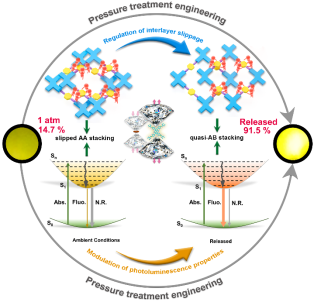
Figure Caption: Achievement of high-efficiency luminescent high-pressure phases of Py-Da-4CH₃-COF retained under ambient pressure via pressure processing engineering and steric hindrance modulation.
Dr. Wang Yixuan, Associate Research Fellow at the State Key Laboratory of High Pressure and Superhard Materials / Center for High Pressure Science and Technology Advanced Research, Jilin University, is the first author of this paper. Postdoctoral Fellow Liu Yaozu, a Dingxin Scholar at the State Key Laboratory of Inorganic Synthesis and Preparative Chemistry, Jilin University, is the co-first author. The corresponding authors are Professor Yang Xinyi and Professor Zou Bo from the State Key Laboratory of High Pressure and Superhard Materials / Center for High Pressure Science and Technology Advanced Research, Jilin University, and Professor Fang Qianrong from the State Key Laboratory of Inorganic Synthesis and Preparative Chemistry, Jilin University.
This research was supported by the National Natural Science Foundation of China and the National Key Research and Development Program of China, and received strong technical support from Beamline B2 of the National Major Science and Technology Infrastructure—Comprehensive Extreme Conditions Research Facility.
Full-text link:https://doi.org/10.1126/sciadv.aeb5242




 Links: